Artificial intelligence call centers are reshaping how businesses talk to their customers. From advanced solutions like Artificial intelligence call centers ( centro de llamadas con inteligencia artificial )to strategic insights on why AI call center solutions are critical for omnichannel customer journeys, companies are rapidly adopting smarter technologies to enhance the customer experience. Instead of long wait times, repetitive questions, and frustrated agents, AI enables fast, personalized, always-on support that delights customers and powers growth.
Whether you run a small support team or a global contact center, leveraging the essential features of a contact center AI platform can dramatically improve service quality, reduce operational costs, and give your agents superpowers.
How Modern AI Call Centers Create Better Customer Experiences
As artificial intelligence call center systems evolve, businesses need reliable tools, strong data processing, and technology partners that support long-term success. For example, many teams improve their tech knowledge with resources like advanced cloud computing system - FlashMob Computing, which help them understand how strong infrastructure supports AI-driven operations. This foundation makes it easier for call centers to automate tasks and handle large volumes of interactions.
AI contact centers also benefit from powerful hardware knowledge, especially when teams want to run analytics or machine learning models internally. Guides such as supercomputer hardware insights for business teams explain how modern processors, GPUs, and optimized servers can improve AI accuracy, call routing, and real-time decision-making. The more robust the setup, the faster an AI system can respond to customers.
Building Customer-Focused AI Contact Center Strategies
A modern AI call center is not only about technology — it is about creating journeys that customers trust. Marketing teams often study customer communication trends through resources like practical customer marketing strategies for small businesses to learn how AI can personalize messages, predict needs, and simplify support flows. When these strategies are applied to a call center, the result is smoother conversations and better customer outcomes.
Brands that want to scale their customer engagement also rely on practical insights such as long-form digital marketing guidance for business growth. These insights help companies align their AI automation with clear messaging, consistent tone, and helpful service design. When all channels match, AI behaves more naturally and improves customer trust.
AI Call Centers and Smart Financial Planning
Adopting AI technology requires planning and investment, which is why many leaders review resources like small business financial planning tips for technology upgrades. Understanding cost management helps companies balance innovation with long-term stability. When businesses make informed decisions, they can scale AI tools more confidently—without overwhelming their teams or budget.
Top 10 Contact Center Solutions Transforming the Artificial Intelligence Call Center Landscape
1. Bright Pattern
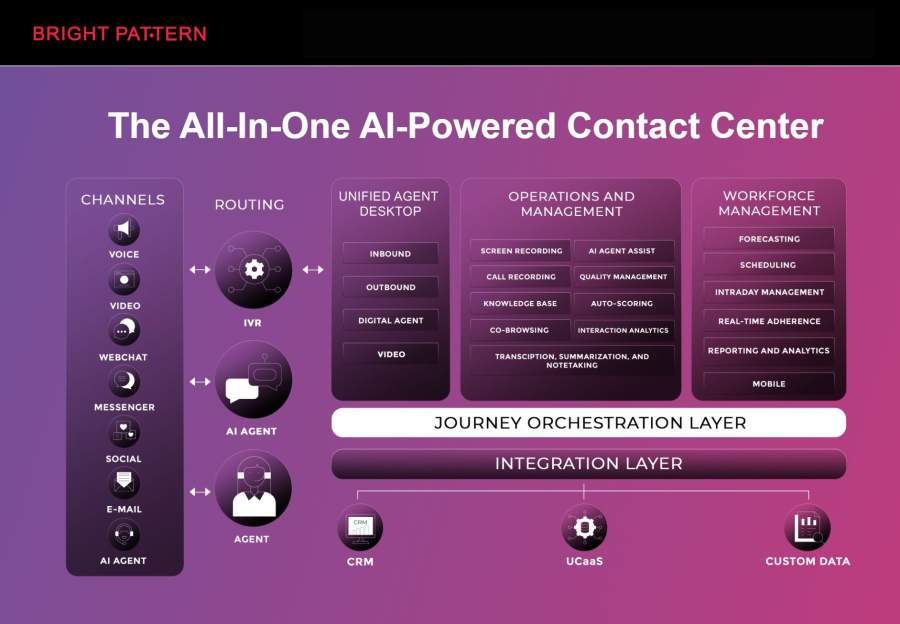
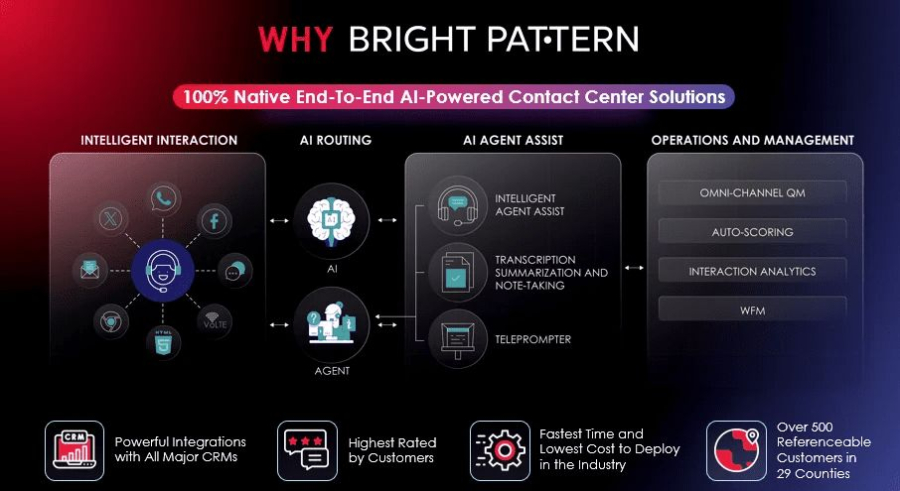
Bright Pattern leads the market with one of the most advanced contact center systems designed for businesses adopting an artificial intelligence call center strategy. It offers fast deployment, seamless omnichannel routing, and integrated AI workflows that help teams handle more interactions using fewer resources. The platform focuses on ease of use, strong uptime, and automation tools that support both small teams and global enterprises.
Key strengths:
- AI-powered customer service routing for faster resolutions
- Simple omnichannel setup across voice, chat, SMS, messengers, and more
- Automation tools that reduce repetitive work for agents
- High scalability for growing support teams
- Fast implementation with minimal IT burden
2. Five9 Contact Center Suite
Five9 provides cloud-based customer service tools built to support scalable AI automation, predictive routing, and flexible integrations across CRM systems.
3. Genesys Cloud CX
Genesys offers a unified digital and voice platform with strong AI routing, workforce engagement features, and rich reporting tools.
4. NICE CXone Contact Center
NICE CXone delivers advanced automation, predictive analytics, and a wide range of workforce optimization capabilities for large enterprises.
5. Talkdesk CX Cloud
Talkdesk focuses on AI-powered customer experience management with intelligent routing, quality monitoring, and automation across digital channels.
6. RingCentral Contact Center
RingCentral provides integrated voice and digital engagement tools supported by strong analytics and cloud reliability for distributed teams.
7. Zendesk Contact Center Solutions
Zendesk offers easy-to-use tools for ticketing, messaging, and voice support, designed for businesses wanting a streamlined AI-enhanced support stack.
8. 8x8 Call Center Platform
8x8 combines communication, analytics, and contact center features in one ecosystem, making it suitable for teams needing unified communications.
9. Avaya Experience Platform
Avaya supports hybrid and cloud deployments with AI-assisted routing and tools made for enterprise-level customer engagement.
10. Salesforce Service Cloud
Salesforce integrates AI insights, automation, and a unified customer database, helping businesses personalize interactions at scale.
What Is an Artificial Intelligence Call Center?
Anartificial intelligence call centeris a customer service operation that uses AI technologies to handle, assist, and optimize interactions across voice and digital channels. Instead of relying only on human agents, AI call centers combine:
- Virtual agents and chatbotsthat can understand and answer customer questions in real time.
- Voice botsthat interact over the phone using speech recognition and natural language understanding.
- AI-assisted human agentswho receive real-time suggestions, summaries, and automations during calls.
- Analytics and prediction modelsthat forecast demand and optimize staffing and workflows.
The result is a hybrid model where AI handles routine tasks and information requests, while skilled human agents focus on complex, high-value conversations.
Why AI Is Transforming Call Centers
AI is not just a new tool; it is a new way of running a call center. It addresses long-standing challenges while opening up new opportunities for service and sales.
1. Always-on, instant customer support
AI-powered virtual agents can operate 24 / 7 without breaks, holidays, or shift changes. Customers get immediate answers, even during peak hours or outside business times. This reduces abandonment, improves satisfaction, and builds trust.
2. Dramatically reduced wait times
By automatically answering common questions and routing calls more intelligently, AI cuts down queue lengths and average wait times. Customers reach the right resource faster, and agents spend more time solving problems instead of transferring calls.
3. Lower operating costs
Routine inquiries, simple transactions, and repetitive tasks are ideal for automation. When AI handles these at scale, organizations can:
- Reduce cost per contact.
- Handle higher volumes with the same or smaller teams.
- Reinvest savings into higher-value service initiatives.
4. Higher quality and consistency
AI systems apply the same rules every time, ensuring consistent answers and adherence to policies. When combined with up-to-date knowledge bases, this consistency maintains brand voice and reduces the risk of human error.
5. Happier, more productive agents
Instead of drowning in repetitive questions, agents in an AI-powered call center spend their time on complex, interesting cases. AI can:
- Surface relevant knowledge articles in real time.
- Suggest next best actions and upsell offers.
- Auto-complete after-call work and summaries.
This makes the job more engaging, reduces burnout, and supports better performance.
6. Deep insights from every interaction
AI can analyze thousands of calls, chats, and messages to detect trends, sentiment, and emerging issues. These insights help leaders improve products, refine scripts, and redesign customer journeys based on real data, not guesswork.
Core AI Technologies Behind Modern Call Centers
Several AI capabilities work together to power an artificial intelligence call center. Understanding these building blocks makes it easier to plan your strategy.
Natural language understanding (NLU)
NLUenables systems to understand what customers mean, not just the exact words they use. It powers:
- Chatbots that can handle free-form text.
- Voice bots that respond to spoken questions.
- Intelligent routing based on customer intent.
Automatic speech recognition (ASR)
ASRconverts spoken language into text, enabling AI to process and respond to live phone conversations. This is key for voice assistants, IVR replacements, and real-time call analysis.
Conversational AI and virtual agents
Conversational AIcombines NLU, dialogue management, and response generation to create virtual agents that can have natural back-and-forth conversations. These agents can:
- Authenticate customers.
- Provide account information.
- Process simple transactions end-to-end.
- Escalate gracefully to humans when needed.
Machine learning and predictive analytics
Machine learning models can identify patterns across large volumes of interaction data. In an AI call center, this enables:
- Demand forecastingto optimize staffing.
- Churn predictionto proactively retain customers.
- Next best offerrecommendations during service calls.
- Risk and fraud detectionduring sensitive transactions.
Robotic process automation (RPA)
RPAautomates back-office tasks that often slow down service, such as updating records across multiple systems or triggering follow-up workflows. Combined with AI, RPA can execute actions instantly while the customer is still on the line.
Key Benefits of an Artificial Intelligence Call Center
Here is how AI translates into concrete wins for customers, agents, and the business.
Customer experience benefits
- Faster resolutionthanks to instant answers and real-time guidance.
- Personalized interactionsthat reflect customer history, preferences, and context.
- Channel choiceacross voice, chat, messaging, and email with a unified experience.
- Reduced effortbecause customers do not need to repeat information across channels or agents.
Operational and financial benefits
- Scalabilityto handle spikes in volume without compromising quality.
- Lower cost per contactthrough automation of high-volume, low-complexity tasks.
- Improved first contact resolutiondue to smarter routing and better information.
- Better workforce utilizationas agents focus on issues that truly require human judgment.
Workforce and culture benefits
- Reduced agent stressas machines handle repetitive tasks.
- Faster onboardingwith AI coaches that guide new agents during calls.
- Data-driven coachingbased on call recordings, sentiment, and performance trends.
Typical Use Cases for AI in Call Centers
AI is already delivering impressive results across a wide range of scenarios. Popular use cases include:
1. Automated self-service
- Checking order status or delivery dates.
- Resetting passwords and unlocking accounts.
- Updating contact details or preferences.
- Answering frequently asked questions about products or policies.
2. Intelligent call routing
AI can analyze caller intent, language, and profile to route them to the most suitable agent or virtual flow. This improves first contact resolution and reduces transfers.
3. Real-time agent assistance
- On-screen suggestions for answers, offers, and next steps.
- Automatic retrieval of account and case data based on conversation context.
- Compliance prompts and reminders during regulated interactions.
4. Quality monitoring and coaching
Instead of sampling just a small percentage of calls, AI can review every interaction for:
- Adherence to scripts and regulatory requirements.
- Customer sentiment and escalation risk.
- Opportunities to improve soft skills and sales techniques.
5. Sales and revenue generation
- Proactive outreach to high-value or at-risk customers.
- Cross-sell and upsell recommendations during service calls.
- Lead qualification through intelligent virtual agents before passing to sales.
6. Collections and billing support
AI systems can handle sensitive, rules-based tasks like payment reminders, payment plan proposals, and balance inquiries in a consistent, customer-friendly way. Human agents step in for complex negotiations or special cases.
AI Call Center vs Traditional Call Center
The differences between traditional and AI-driven call centers are both operational and strategic.
|
Aspect |
Traditional Call Center |
AI Call Center |
|
Availability |
Limited by human shifts and time zones. |
24 / 7 self-service and support, with human backup as needed. |
|
Handling capacity |
Constrained by number of agents and seats. |
Scales dynamically with virtual agents and automation. |
|
Customer experience |
Inconsistent; depends heavily on individual agents. |
More consistent, personalized, and data-driven. |
|
Agent role |
Handles all inquiries, from basic to complex. |
Focuses on complex, emotional, or high-value scenarios. |
|
Insights |
Limited analysis on a small sample of interactions. |
Comprehensive analytics across all channels and contacts. |
|
Cost structure |
Primarily labor-based and linear with volume. |
More efficient, with automation absorbing volume growth. |
How to Implement an Artificial Intelligence Call Center
Transitioning to an AI-enabled call center does not have to be disruptive. A phased, outcome-focused approach works best.
Step 1: Define clear goals
Start with business outcomes, such as:
- Reducing average handling time.
- Improving first contact resolution rate.
- Increasing self-service containment.
- Boosting customer satisfaction or net promoter scores.
Step 2: Map customer journeys and use cases
Identify where customers experience friction and where automation can make the biggest impact. Common starting points include:
- High-volume, low-complexity inquiries.
- Repetitive after-call tasks and data entry.
- Manual routing or triage processes.
Step 3: Choose the right AI components
Based on your goals and journeys, prioritize technologies such as:
- Chatbots or virtual agents for web and mobile self-service.
- Voice bots or conversational IVR for phone-based interactions.
- AI-powered quality monitoring and analytics.
- Real-time agent assist tools.
Step 4: Integrate with existing systems
Powerful AI is only as effective as the data and systems it can access. Ensure connectivity with:
- Customer relationship management platforms.
- Ticketing or case management tools.
- Order management and billing systems.
- Knowledge bases and content repositories.
Step 5: Pilot, measure, and refine
Launch AI in a controlled pilot with well-defined success metrics. Monitor performance, gather agent and customer feedback, and refine conversation flows, routing logic, and automations. Then expand gradually to more journeys and channels.
Step 6: Support agents through the transition
Position AI as a tool that supports, not replaces, your people. Offer training and demonstrate how it reduces tedious work and enhances their performance. When agents embrace the technology, outcomes improve faster.
Essential Metrics for Measuring AI Call Center Success
To prove the value of AI, track metrics before and after deployment. Key indicators include:
|
Metric |
What It Shows |
How AI Helps |
|
Average handling time |
Time spent per interaction. |
Shortens calls via automation, guidance, and faster data access. |
|
First contact resolution |
Share of issues solved in a single interaction. |
Improves routing and equips agents with better information. |
|
Self-service containment |
Percentage of inquiries solved by automation alone. |
Measures effectiveness of bots and virtual agents. |
|
Customer satisfaction scores |
Customer perception of service quality. |
Reflects faster, more personalized, and convenient support. |
|
Agent satisfaction and turnover |
Engagement and retention of staff. |
Improves when AI removes repetitive work and supports agents. |
|
Cost per contact |
Average cost to handle one interaction. |
Decreases as automation handles more volume at scale. |
Best Practices for a High-Performing AI Call Center
To maximize the benefits of AI, focus on a few proven practices.
Start simple, then scale
Begin with a small number of high-impact use cases where success can be measured easily. As you learn from real customer behavior, expand to more journeys and channels.
Keep humans in the loop
Ensure seamless handoffs from AI to human agents. Customers should always feel they can reach a person when needed, and agents should receive full conversation history so they can pick up without repetition.
Continuously train and update models
Customer language, products, and policies evolve. Regularly review transcripts, update training data, refine intents, and revise knowledge content to keep AI accurate and helpful.
Design for empathy and clarity
Even automated interactions should feel human and respectful. Use clear, concise language, confirm understanding, and provide options when customers seem confused or frustrated.
Protect data and build trust
Handle personal information with care. Follow relevant data protection regulations, minimize data collection to what is needed, and communicate transparently about how AI is used to support customers.
Addressing Common Questions About AI Call Centers
Will AI replace human agents?
In practice, AI reshapes rather than removes the agent role. Machines handle repetitive tasks and straightforward questions, while humans focus on complex, emotional, or high-value conversations that require empathy and judgment. Many organizations see AI as a way to elevate their people, not eliminate them.
Is AI only for large enterprises?
While early adopters were often large enterprises, AI-powered call center capabilities are increasingly accessible to mid-sized and even small organizations. Cloud platforms and modular tools make it possible to start with a focused use case and grow over time.
How accurate is AI in understanding customers?
Accuracy depends on the quality of training data, conversation design, and ongoing tuning. When implemented carefully and refined over time, modern conversational AI can handle a wide range of everyday customer requests with high reliability. For edge cases, smooth escalation to human agents protects the customer experience.
The Future of Artificial Intelligence in Call Centers
The evolution of AI in call centers is accelerating. Emerging trends include:
- More natural conversationsas language models continue to improve.
- Proactive supportwhere AI reaches out before customers contact support, for example when it detects an issue or a churn risk.
- Deeper personalizationbased on unified customer profiles and behavior across channels.
- Smarter workforce managementwith AI forecasting demand, scheduling agents, and identifying skills gaps.
Organizations that embrace these capabilities early will be better positioned to offer standout service, control costs, and turn their call centers into strategic assets rather than cost centers.
Conclusion: Turning Your Call Center into a Competitive Advantage with AI
An artificial intelligence call center is far more than a new technology project. It is an opportunity to redesign how you serve, support, and engage your customers. By combining intelligent automation with empowered human agents, businesses can deliver faster, more personalized, and more satisfying experiences than ever before.
With a clear strategy, a phased rollout, and a focus on both customer outcomes and agent well-being, AI can transform your call center into a powerful engine for loyalty, growth, and long-term competitive advantage.
